
Projects Trump Praise

Churches know Sunday morning gives them a captive audience. Using worship time to pitch projects and fundraising can turn attention from God to money.
It happens all the time.
Someone has been trying to get a friend, coworker or family member to come to church for months. Come this Sunday. Just give it a chance. Finally, for whatever reason, they agree.
And naturally, this is the Sunday the church decides to talk about money.
Not passing an offering. Not a thirty-second announcement reminding everyone where they can give. Today everyone gets to hear about the new wing.
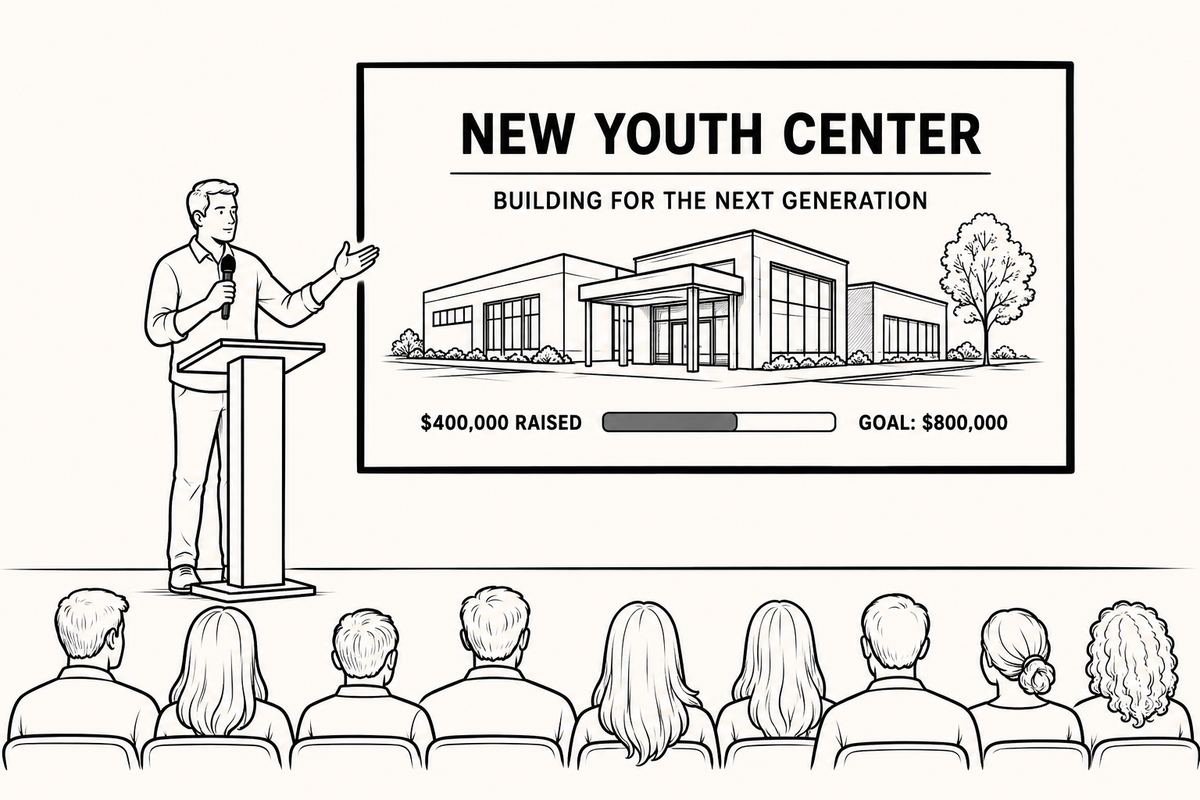
The church has already raised $400,000, but another $400,000 is needed. There are plans to explain, numbers to go over and a vision for what this new space will eventually become. Maybe it’s a youth center. Maybe it’s a bigger auditorium. Maybe it’s a renovation nobody knew was desperately needed until five minutes ago.
Whatever it is, the visitor who finally agreed to come to church is now sitting through a sales presentation about a building belonging to a church he hasn’t even decided he likes yet.
Awesome.
Churches have to deal with money. That’s reality. A church is a business regardless of how uncomfortable that word may make some people. It has bills. It has employees. It has payroll. It has insurance. It has utilities. It has property to maintain. It markets itself. It tries to attract new people. It needs money coming in if it plans on keeping the doors open.
None of that is particularly scandalous. Things cost money.
But businesses also understand the value of a captive audience.
Radio has understood it forever. Morning and afternoon drive times are valuable because millions of people are sitting in their cars going somewhere. Advertisers know where the audience is, they know when the audience will be there, and they pay good money for the opportunity to get their message in front of them.
Churches apparently understand this principle pretty well too.
Sunday morning rolls around and hundreds of people have already driven to the building, parked, walked inside and sat down. They’ve committed an hour or more of their time to being there. Nobody has to convince them to open an email. Nobody has to hope they’ll attend a Wednesday night meeting. Nobody has to wonder whether they’ll click on a link.
They’re already sitting there. Might as well tell them about the new wing.
Eminent Domain Over Worship
There’s something almost like eminent domain happening here.
A city wants to build a road. Unfortunately, someone’s property happens to be where the road needs to go. The project has been determined to serve the greater good, so the city has a mechanism for taking the property it needs to make the project happen.
Obviously nobody legally owns fifteen minutes of a Sunday service, and no church is literally exercising eminent domain over anyone’s time.
But metaphorically, it’s pretty close.
The church has a project. The project needs money. The church needs to explain why the project is important and why people should help pay for it. There are only so many opportunities to get everybody together at once, so the church looks around and discovers a nice piece of available real estate right in the middle of Sunday morning.
That’ll work. After all, it’s for the greater good. And maybe it is.
Maybe the youth center really is needed. Maybe the building really is too small. Maybe the roof leaks. Maybe the children’s ministry has completely outgrown its space. Maybe the new addition will be used for wonderful things for the next fifty years.
By all means, build it.
None of that explains why the sales presentation has to happen during the limited amount of time people specifically set aside to gather at church.
There are 168 hours in a week. Somehow the financial presentation keeps finding its way into this one.
Send an Email
This isn’t the 1980s.
A church no longer has to wait until Sunday morning because that’s the only time it can communicate with everybody.
Churches have email lists. They have websites. They have apps. They have social media accounts. They send text messages. They livestream. They can upload videos. They can put every architectural drawing, budget, construction estimate and fundraising goal online and leave it there twenty-four hours a day.
Send an email.
Put “Our New Youth Center” in the subject line. Explain exactly why it’s needed. Show what it’s going to look like. Tell everyone that $400,000 has already been raised and another $400,000 is needed. Include a link for anyone who wants to contribute.
Hold a meeting Wednesday night. Hold it immediately after the church service.
Make an announcement that anyone interested in learning about the proposed expansion can stay afterward. That takes about twenty seconds and gives everyone who actually wants to hear the presentation the opportunity to hear it.
Of course, not everybody will stay. And there’s the problem.
A Wednesday night meeting probably won’t have as many people. An email can be deleted. A text can be ignored. A video doesn’t have to be watched.
The Sunday morning congregation is already sitting there.
Which is precisely why using that time for the pitch feels less like necessity and more like strategy.
But Giving Is Biblical
Of course it is. The Bible dedicates a lot of passages to giving.
The more interesting question is exactly what Christians are required to give. The tithe is deeply rooted in the Old Testament. Abraham gave Melchizedek a tenth long before the Mosaic Law, and Melchizedek himself becomes a fascinating figure once Hebrews enters the conversation.
The New Testament certainly doesn’t abandon giving. What it does contain is a remarkably simple statement from Paul:
“Each one must do just as he has decided in his heart, not reluctantly or under compulsion, for God loves a cheerful giver.”
— 2 Corinthians 9:7
Whether the Old Testament tithe remains binding on Christians, whether ten percent is still the standard, or whether New Testament giving is fundamentally voluntary deserves its own discussion.
But none of that changes the issue here.
Believe Christians should give ten percent. Believe they should give more. Believe they should give according to what they have decided in their own hearts.
Fine.
That still doesn’t explain why a construction project needs part of Sunday morning. Giving can be biblical while the method used to solicit it can still be questioned.
And putting people in a room where they came for one purpose, then using that opportunity to sell them on something else because they’re already there deserves to be questioned. Especially when churches spend so much time trying to get new people into that room.
The Worst Possible Sunday
There’s really no such thing as a good Sunday to spend a significant chunk of the service talking about finances because every Sunday is somebody’s first Sunday.
Churches constantly encourage people to invite friends. Invite family. Invite coworkers. Reach people who haven’t been to church in years. Reach people who have never been to church at all.
Eventually somebody succeeds.
A person who has resisted invitation after invitation finally walks through the doors.
Maybe they’re skeptical. Maybe they’ve had bad experiences with churches before. Maybe they already believe churches are mostly interested in money. Maybe they don’t know enough about Christianity yet to have an opinion about much of anything.
And now they’re sitting through a presentation about an $800,000 building project.
What exactly are they supposed to think?
They don’t know the church. They don’t know the pastor. They don’t know how the finances are handled. They don’t know whether anyone expects them personally to give a dime.
All they know is that somebody finally convinced them to come to church and, before they made it back to the parking lot, the church was talking about how much money it needs.
Maybe the church’s intentions are completely honorable. The visitor can’t read intentions. They can only watch what’s happening.
And what they’re watching looks an awful lot like one of the oldest stereotypes about church being confirmed right in front of them.
It took six months to get someone through the door. It only took fifteen minutes to convince them they were right to stay away.
The Captive Congregation
The uncomfortable part is that churches know how valuable Sunday morning is.
That’s why major announcements happen then. That’s why new initiatives are introduced then. That’s why fundraising efforts are discussed then.
Everybody is there.
But that’s exactly why the time should be treated as valuable to the people sitting in the seats too.
They didn’t come to hear the quarterly earnings call.
Yes, the church needs money. So does every business. There is nothing wrong with telling people what the church needs, showing them where the money is going or asking them to support something worthwhile.
But none of that requires taking over the service.
Explain the project. Show the plans. Tell people what it costs. Send the email Monday. Hold the meeting Wednesday. Give anyone who wants to participate every opportunity to give willingly and cheerfully.
There are plenty of ways to make the pitch without taking advantage of the one time the church knows nearly everyone will already be sitting there.
Projects Trump Praise
The title isn’t exaggerating anything.
For however long the financial presentation lasts, the project literally trumped the praise.
There was a limited amount of time available, and the church deliberately chose to spend part of it discussing a project, its financing and the amount of money still needed to make it happen.
Call it a vision presentation. Call it stewardship. Call it an exciting opportunity. Call it whatever sounds best on the PowerPoint. It’s still a sales pitch.
And the reason it happens Sunday morning isn’t difficult to figure out. That’s when the church has its largest captive audience.
It’s just smart business. But is it wise?
COMMENTS
No comments yet. Start the trouble.