
Grande Sermon with Heavy Whip
TORCH INDEX
0 COMMENTSWhen commerce enters the church, does modernization cross the line into marketplace?
A brief disclaimer before going any further. This website was not created to become a series of articles indicting the modern church for its various affronts to Christianity.
But if the shoe fits.
There has already been Hide the Band, questioning whether worship has slowly become performance. Then Projects Trump Praise, questioning the use of precious worship and sermon time to discuss money, expansion and the next big building project. And now, apparently, there's this issue with the coffee shop.
This isn't an argument that nobody should drink coffee at church. Bland coffee and glazed donuts are Sunday School staples. Nor is this an argument that every church should have wooden pews, hymnals and an organ. Technically, an argument could be made for simpler things being more reverant, but there's no need to go there right now.
All that said, there is no reason to pretend nobody knows what church is supposed to look like. The New Testament does a pretty good job of explaining what proper worship and fellowship looks like.
And, conveniently, it also tells a rather memorable story about what happened when buying, selling and making money found their way into a place dedicated to God.
Jesus didn't order a latte. He made a whip.
Would You Like a Muffin with Your Worship?
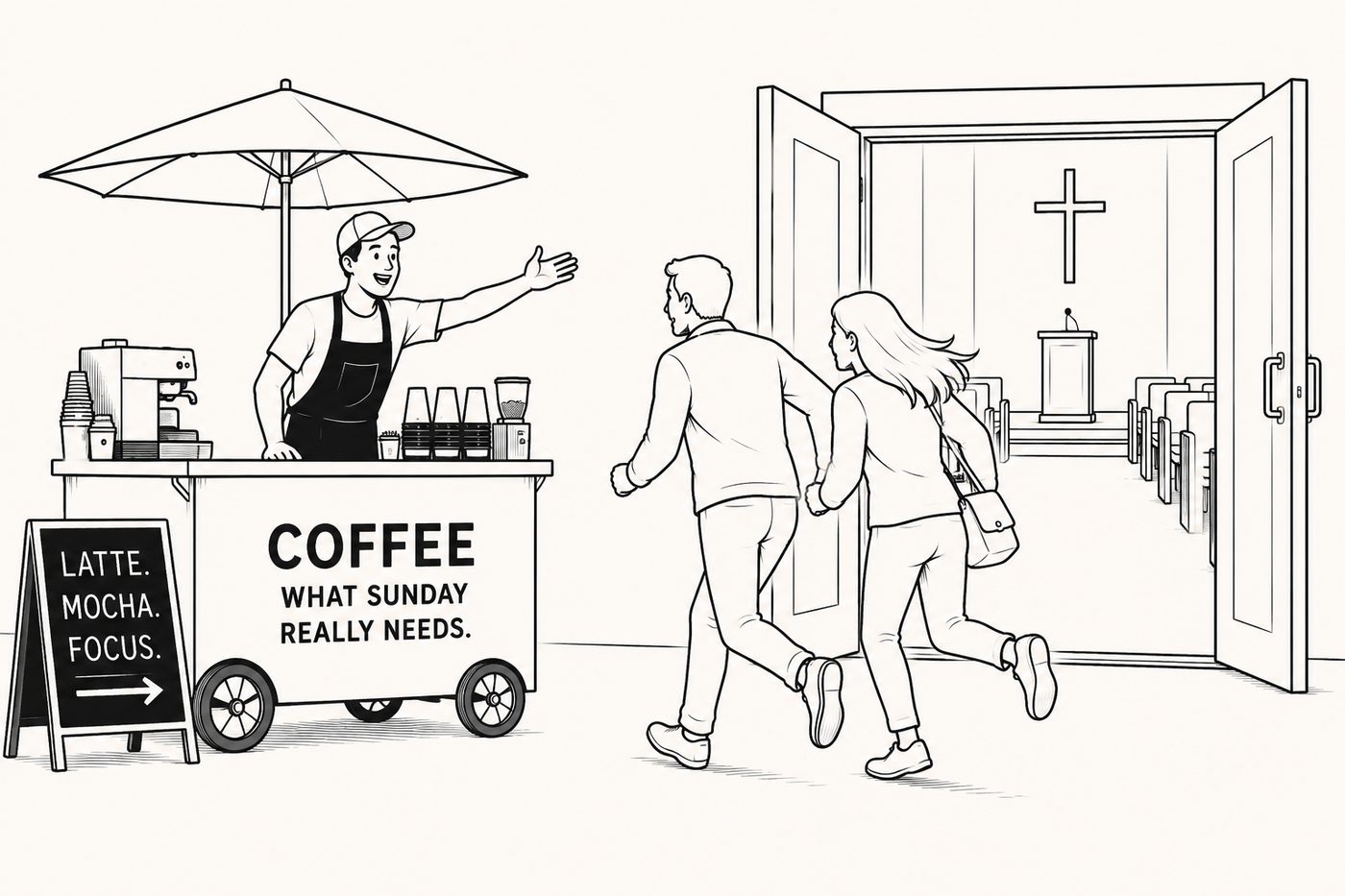
Walk into some modern churches today and somewhere between the front door and the sanctuary there may be something resembling a small commercial district.
A coffee shop. A breakfast cart. Pastries. Specialty drinks with more than five words in their titles.
Maybe an outside vendor operating the whole thing, separating you from your cash before the offering plate reaches you.
Hundreds or even thousands of people arrive at roughly the same time every Sunday morning, walk directly past the counter and remain in the building for the next hour or two. From a business perspective, is doesn't get much better than that.
No advertising campaign necessary. No worrying about foot traffic. No hoping customers happen to wander through the door because the church already gathered them.
Except they weren't gathered to become customers. They came to worship. Therein lay an important distinction here.
A church brewing coffee and accepting a few dollars that ultimately support missions, benevolence or some other ministry is one thing. The money remains tied to the work of the church. Allowing a private business to operate inside the church and profit from the congregation is something else entirely.
At that point, the congregation has unwittingly become a captive audience. And access to that audience has serious commercial value.
We've Seen This Movie Before
All four Gospels record Jesus cleansing the temple.
Matthew describes Jesus entering the temple and driving out those who were buying and selling. He overturned the tables of the money changers and the seats of those selling doves.
Mark and Luke recount the same confrontation, while John supplies the particularly uncomfortable detail of Jesus making a whip out of cords.
Let's take a step back. Of course there are important differences between the temple merchants and a modern-day coffee shop.
The temple commerce existed within a sacrificial system. Animals were being sold. Money was being exchanged. Questions of exploitation, location and corruption surround the accounts.
A breakfast taco vendor isn't a first-century money changer. A barista isn't selling sacrificial doves. Nobody needs to pretend otherwise, but let's also not pretend there isn't an uncomfortable similarity staring everyone in the face:
Private commerce has been invited into a place dedicated to God to make money from the people who came there to worship.
The situations don't have to be identical for them to both be bad.
Modernizing the Church
Much of this seems to come from the endless effort to make church feel modern.
The building becomes more contemporary. The sanctuary becomes an auditorium. The worship area gets theatrical lighting. The musicians become a stage production. The lobby becomes a gathering space. Then come the café, the breakfast cart and the specialty coffee.
The thing is, each addition can be defended individually with the right spin. None of them is inherently sinful on its own. But combined, they start to make Sunday look a lot more like Monday through Saturday.
If the church keeps borrowing pieces of the world around it in an effort to become more attractive to the world around it, it's going to stop looking and feeling like an actual church.
And Scripture is all about doing the opposite. Romans 12:2 begins with a remarkably straightforward command: “Do not be conformed to this world.”
Yet conformity is the new norm. Church should feel familiar. Church should feel comfortable. Church should feel contemporary. Church should look like somewhere people already enjoy going. Why is church getting all these "shoulds" thrown at it?
Christianity was never instructed to make itself resemble the surrounding culture closely enough that nobody would notice the transition when they walked through the doors. In fact, the reverse is true.
The church is supposed to be different. So, why does modernizing church so frequently mean making church look more like everything that isn't church?
The Captive Audience
Consider the arrangement without coffee.
Suppose a church allowed an insurance agent to put a desk in the lobby every Sunday morning. Maybe a realtor could set up beside him.
A local dealership could park an SUV near the entrance. A financial adviser could hand out business cards near the sanctuary. Maybe let the church rent booth spaces to all the small businesses in town looking to capitalize on the worshippers.
After all, everybody benefits. The businesses get customers. The congregation gets convenient services. The church gets a more vibrant lobby.
It sounds absurd because the commercial relationship is impossible to ignore. Yet put espresso behind the counter and somehow it feels different.
But why?
The church provides the building. The church provides the foot traffic. The church provides the occasion. Most importantly, the church provides access to a group of people who did not assemble there to shop.
That access is valuable.
A private vendor is being permitted to prey upon a captive audience assembled for worship and extract private profit from it.
Whether the product is a mortgage, a breakfast sandwich or a caramel macchiato doesn't change that basic arrangement.
What Did Church Lack?
Strip away the commercial language and another question appears.
What problem did the coffee shop solve?
Christians were already capable of fellowship. They were already capable of gathering before services. They were already capable of talking afterward. They were already capable of drinking the free coffee.
Was it because the bland coffee was free and therefore drained a budget somewhere? If so, put a donation box next to the pot. Boom. Done. There was no need to bring in a wannabe Starbucks next to the Life Group table.
Did the café improve worship? Did it improve prayer?
Did it improve the teaching of Scripture? Did it make disciples? Did it feed the hungry? Did it spread the Gospel?
Or did it simply make church feel a little more like the commercial world everyone had just walked in from?
Because maybe that's the real product being sold here. Not the coffee. The church.
The café helps make the church feel modern. Relevant. Somewhere people want to hang out. Somewhere that feels cool.
But when did cool become something the church was supposed to worry about?
Christianity isn't supposed to be marketed into relevance. The church isn't supposed to conform itself to whatever the world currently finds appealing. It's supposed to offer something the world doesn't.
The Marketplace Stops Here
Okay, let's talk business. There is nothing inherently wrong with capitalism. Commerce puts food on tables, creates jobs, rewards ingenuity and allows people to build something valuable enough that somebody else willingly pays for it.
The marketplace has its place, but that place isn't the church.
Not because capitalism suddenly becomes evil when it crosses the threshold, but because the church is supposed to be reverent. Holy. Set apart. Do those words ring a bell?
There should be at least one place where everything isn't for sale. One place where a gathering of hundreds or thousands of people isn't immediately recognized as a marketing opportunity. One place where nobody looks at a crowd and calculates what percentage might buy a muffin or breakfast taco.
The church doesn't need more secularism brought inside its walls in an attempt to make Christianity feel familiar to the secular world. The entire point is that Christianity calls people out of that world and toward something different. At least for a few hours a week.
“Do not be conformed to this world.”
That's not particularly ambiguous. In fact, it couldn't be much clearer.
The church can exist in a capitalist society without becoming a marketplace itself. It can welcome business owners without becoming their place of business. It can serve coffee without turning the congregation into customers.
Reverence requires boundaries.
You can't argue with the fact that the world has plenty of places to buy a latte. There are probably too many already without adding one inside the church.
Grande Sermon with Heavy Whip
There should be some places where people are not viewed as potential customers.
Surely the church qualifies.
The people walking through those doors came to worship God. They should not simultaneously become a commercial opportunity simply because somebody noticed how many of them gather in one building every Sunday morning.
Especially when Christianity already has a famous story involving merchants, money and sacred space.
The merchants had customers. The customers apparently wanted (well, let's be honest, were required to have) what was being sold. The commerce could undoubtedly be justified as useful from a certain point of view. But people aren't required to sacrifice doves at an altar anymore, and the Bible says nothing about offering a divine cappuccino to atone for sins. Jesus took care of the atonement. He also took care of those merchants' tables.
The focus of church is God, not a double tall mocha.
Maybe allowing private businesses to profit from churchgoers is modern. Maybe it's convenient. Maybe it's smart business.
But the church isn't supposed to be a business opportunity.
Scripture also warns repeatedly about those who can appear to belong among the flock while serving something else. Maybe the greater danger to the modern church isn't always somebody openly attacking it. Maybe sometimes it's somebody inside it convincing everyone that a little more marketing, a little more commerce and a little more of the world is exactly what the church needs.
The Bible says to beware of wolves in sheep's clothing. It might be worth checking who's running the marketing department. Because when Jesus encountered commerce where worship belonged, He didn't reach for His wallet.
He reached for a whip.
COMMENTS
No comments yet. Start the trouble.