
Hide the Band
TORCH INDEX
0 COMMENTSWhen worship starts looking like a concert, maybe it's time to hide the band.
Let me paint a picture. It's been a crazy Monday through Friday. The weekend is supposed to be your time to recoup, unwind and reset. Today, you're running late. Parking lot is packed. No biggie, it's always packed but today of all days... just another obstacle in your way you didn't need.
You finally get inside and the music is bumping just beyond the foyer doors. People are clapping and cheering. You worm your way through the crowd and finally find a seat, but everyone's standing and dancing in their spots, focusing on the one thing that has got them fired up, so space is tight.
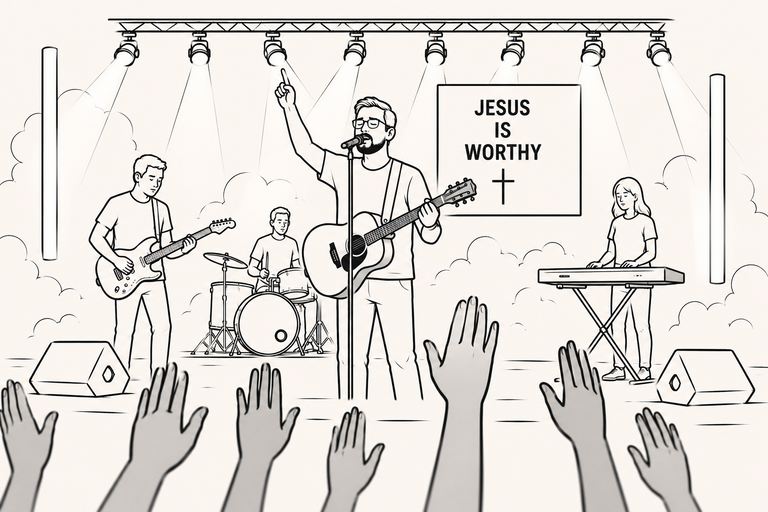
The music is getting louder as all sorts of LED screens flash a multitude of colors and images while the lead singer hits his crescendo and is that... a smoke machine?
The song ends, the crowd goes wild.
The coiffed, dressed-up band members... take bows? They thank the audience, all the while nonchalantly pointing up to the... ceiling... a few times, apparently indicating that it's all about God (or the giant sound system?)
Color you confused, but did you come to church or a concert?
Why are we clapping for the band?
Why are we clapping for the band?
You sort of feel guilty you got in without having to buy a ticket, but at the same time wonder if this was what the Bible meant about worship.
I don't have anything against singing. In fact, I've been known to rock the mic to certain 80s hits and the occasional Garth Brooks showstopper at karaoke night myself.
The Bible obviously doesn't have anything against singing either. Ephesians 5:19 talks about “psalms and hymns and spiritual songs,” and Colossians 3:16 says essentially the same thing. So this isn't some argument that Christians shouldn't sing or that having instruments in church is somehow wrong.
Sing. Play the guitar. Bang on the drums. If you've got someone who can actually carry a tune, by all means let that person help drown out the voices of those who sound like cats fighting.
What I don't understand is why I need to look at them while they're doing it.
That seems like a different thing entirely.
When you actually look at the early church in the New Testament, it doesn't much resemble what happens in a lot of churches on Sunday morning now. Christians gathered in people's homes. Acts 2:46 describes them breaking bread from house to house. Paul mentions churches meeting in homes in Romans 16:5, 1 Corinthians 16:19 and Colossians 4:15. There wasn't exactly a backstage area.
That doesn't mean we all have to sell our church buildings and cram into somebody's living room. Times change. Congregations got bigger. Microphones are useful. Air conditioning is fantastic. I'm not trying to recreate the first century down to the furniture.
But when Paul actually talks about Christians gathering together, the picture is interesting. In 1 Corinthians 14:26 he says, “When you assemble, each one has a psalm, has a teaching, has a revelation...” People were participating. They were teaching, talking, praying and singing. And to be fair, some of that happens in modern churches today. People are definitely singing along. They're participating. They're raising hands. They're being... fans.
Somewhere along the way we added performers at the front of the room.
And started clapping for them.
That's the part that I can't quite get past.
A singer finishes a song at a concert and everybody applauds. Nobody has to explain what just happened. The singer performed and the audience liked it. An actor walks out for a curtain call and everybody applauds. Again, nobody is confused. A comedian finishes a set and everybody applauds. We all understand the arrangement.
But apparently if you put a cross somewhere in the room, the exact same human behavior suddenly means something completely different.
A guy stands under a spotlight, sings a solo, nails the big note, the song ends and hundreds of people who have been staring at him start clapping.
Who are they clapping for?
I'm genuinely asking.
Because the singer knows they're clapping for him. That's why he smiles. That's why he thanks everybody. That's why he has to audition to even be on stage. That's why people tell him afterward how amazing his voice was. He got something out of that performance that he would not have gotten if nobody could see him.
And yes, then comes the finger pointed toward the ceiling to let everybody know the glory belongs to God.
I'm sure some of it does. I'm also pretty sure applause feels good.
Recognition feels good. Having people tell you how talented you are feels good. Having a room full of people watching you do something you're good at feels good. That's not some terrible accusation. That's being a human being.
But let's not pretend that putting someone on a stage, shining lights on them, projecting them onto giant screens and applauding them afterward somehow provides absolutely no personal satisfaction because the lyrics happened to mention Jesus.
So I have a solution.
Hide the band.
Seriously.
Put them behind a wall. Put up a partition. Put them behind the stage. Put them somewhere we can't see them.
Don't change anything else. Or do, by displaying imagery from the Bible across those expensive LED screens if people need something to gaze upon.
Let the band play every instrument exactly the same way. Let the singers sing every note exactly the same way. Let the congregation sing along exactly the same way. Turn the speakers up as loud as you want. Apparently God can hear through drywall, so I don't think we're creating a theological problem here.
What exactly did we lose?
The congregation still gets the music. The congregation still gets someone leading the songs. The musicians still get to use the talents God gave them. Everybody can still sing together. God still gets worshiped. Correction, God gets all the worship.
The only thing that disappeared is the ability to watch the people doing the singing.
And if you're one of the singers and that idea bothers you, I think that's worth examining.
Why do you need us to see you?
You can still sing. You can still use your God-given talent. You can still help the congregation worship. You can still worship yourself. You can still do literally everything that supposedly matters.
The only thing you can't do anymore is be seen doing it.
That seems important.
Jesus had quite a bit to say about people doing religious things while also enjoying being noticed for doing them. Matthew 6:1 says, “Beware of practicing your righteousness before men to be noticed by them.” Jesus wasn't talking about worship bands there, so I'm not going to pretend He was. He went on to talk about giving, praying and fasting.
But the principle is pretty hard to miss. Something can genuinely be done for God and still become something we enjoy other people watching us do.
Apparently human beings had this problem two thousand years ago, too.
Which makes me wonder why singing would somehow be the one religious activity completely immune from ego.
Then there's John the Baptist's wonderfully simple line in John 3:30: “He must increase, but I must decrease.”
That seems like a pretty solid job description for somebody leading worship.
If the entire purpose is to direct attention toward God, becoming less visible seems like it would help accomplish that rather than interfere with it. Yet we've somehow moved in exactly the opposite direction. Bigger stages. Better lighting. Larger screens. More elaborate productions. Better-dressed singers. More dramatic solos. Smoke machines.
Again, I'm not saying any of those individual things are sins. The Bible obviously doesn't contain a verse saying, “Thou shalt not purchase an LED wall.”
I'm asking why worship increasingly looks exactly like entertainment.
Because once you make it look like a concert, you probably shouldn't be shocked when people start behaving like they're at a concert. I'm just wondering when the concession stand is going to open and if wine will be served like at Cana.
You put somebody on stage. You light them up. You amplify their voice. You project their face twenty feet tall. You let them perform the big solo. Then the song ends and everybody applauds.
Maybe the congregation isn't confused at all. Maybe they're responding exactly the way human beings have always responded when somebody performs for them.
The confusing part is insisting that what they just watched wasn't a performance.
So try it one Sunday, church leaders.
Hide the band.
Don't cancel the music. Don't change the songs. Don't tell anybody they can't clap along with the beat or sing loudly or raise their hands or dance in whatever small amount of floor space the person next to them has graciously left available.
Just remove the performers from sight.
If worship suddenly suffers because nobody can see the singer, I'd genuinely like to understand why seeing the singer was necessary for worship in the first place.
And if nothing changes, maybe that's the answer.
Maybe we never needed to see them.
Maybe the musicians really could decrease while the One they're singing about increases.
And maybe when the final note ends, nobody would have to wonder who exactly they're supposed to be clapping for.
COMMENTS
No comments yet. Start the trouble.