
Book of the Wars of the Lord
TORCH INDEX
0 COMMENTSThe Bible quotes a lost book called The Book of the Wars of the LORD. Could one surviving fragment preserve traces of a forgotten battle?
Did Numbers preserve a piece of a forgotten battle?
The Bible is not hurting for interesting stories, nor does it lack tempting rabbit holes to go down. One such rabbit hole is in Numbers 21. This passage contains one of the most rabbit-hole-y references to a lost book in the Bible: The Book of the Wars of the LORD. What? A lost book? About wars? Of the Lord? That practically begs a curious mind to chase it. Who wrote it? How large was it? Which wars did it contain? Was it a collection of songs, historical accounts, or something in between? None of that is known. The book is lost, but Numbers preserves a fragment:
Therefore it is said in the Book of the Wars of the LORD:“Waheb in Suphah,
and the wadis of the Arnon,
and the slope of the wadis
that extends to the site of Ar,
and leans to the border of Moab.”
That is not much to work with, but it may be more than it appears. The usual reading makes Waheb and Suphah look like two ancient places. Or a thing in a place. Like “the Walmart in Suphah.” Most English translations capitalize both words, which naturally pushes the reader in that direction. Biblical Hebrew, however, does not use uppercase and lowercase letters to distinguish proper nouns. The capital "W" and "S" are decisions made in translation, not something preserved in the ancient Hebrew text.
That raises a pretty basic question: Are Waheb and Suphah actually both places?
Waheb Probably Is. Suphah Might Not Be.
Waheb is a mystery. It appears only here, and nobody has securely identified where it was. Still, the grammar and the string of geographical references surrounding it give us good reason to think Waheb probably was a place. We just don't know where.
Suphah is different. The Hebrew word סוּפָה (sûp̄â) already means "storm, tempest, or whirlwind", and it is used elsewhere in the Bible that way. There is also no independently established biblical location called Suphah that requires it to be a place here.
This isn't a new observation. Ancient translators couldn't agree on what to do with the phrase, and later interpreters included those who understood sûp̄â as a whirlwind or storm. Some took that storm figuratively, as a way of describing a sudden or violent conquest.
But what if it wasn't figurative? What if “Waheb in Suphah” is really telling us about "Waheb in a storm?"
Keep Reading
The next words matter:
“and the wadis of the Arnon,
and the slope of the wadis
that extends to the site of Ar,
and leans to the border of Moab.”
Now we're on much firmer geographical ground. Moab is Moab. Ar is associated with Moab. The Arnon is generally identified with the modern Wadi Mujib, a rugged canyon and drainage system east of the Dead Sea.
A wadi is essentially a valley, ravine, or watercourse common in dry regions. It may sit dry or relatively quiet until heavy rain sends runoff pouring through it. In steep terrain, that can turn a wadi into a violent torrent very quickly.
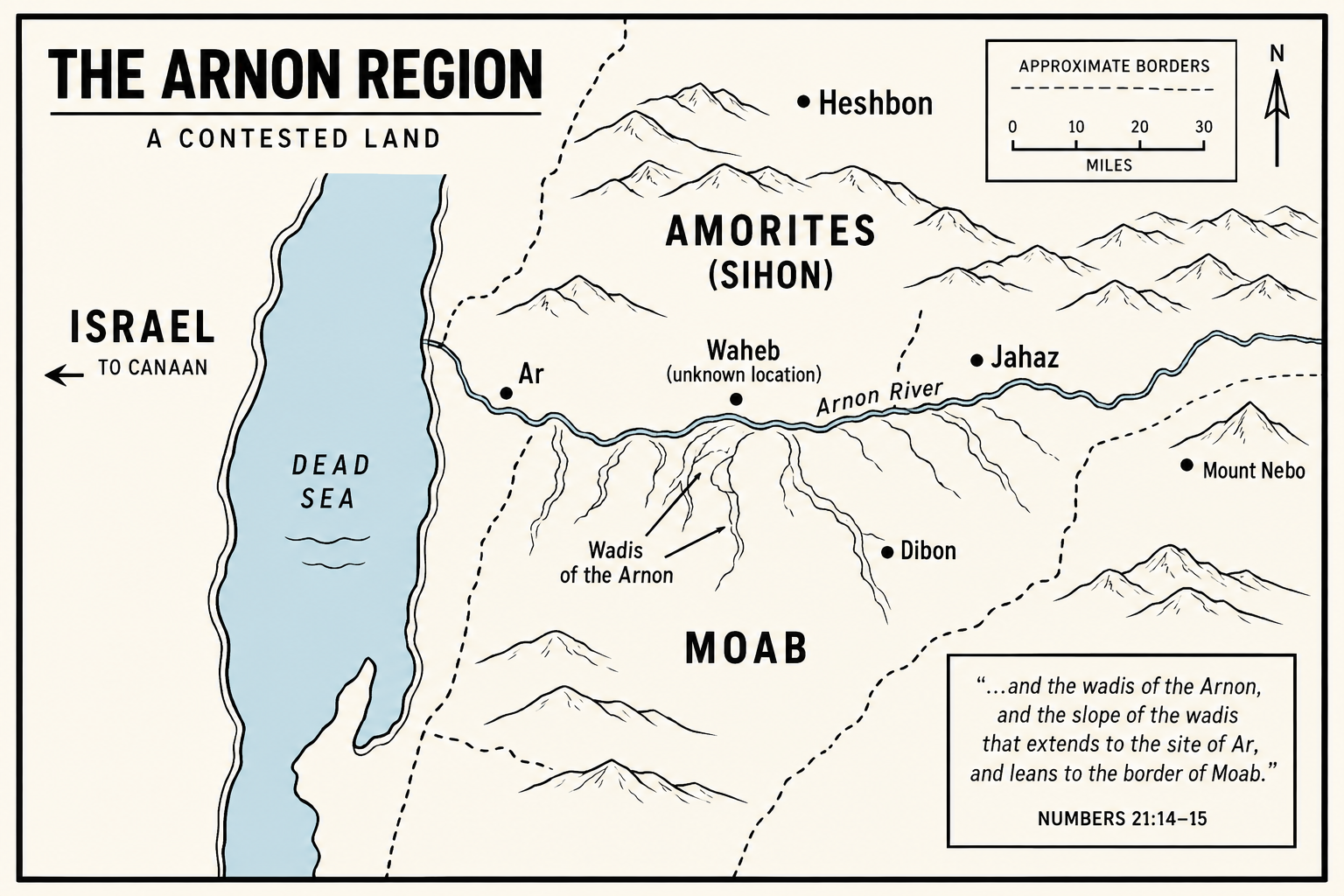
So read the surviving clues together: Waheb. A storm. The wadis of the Arnon. Their slopes. Ar. The border of Moab. And all of it supposedly came from The Book of the Wars of the LORD.
Maybe Suphah really was a place. Maybe “storm” was just poetic language. Or maybe there was a storm.
Which War?
Numbers may give us a suspect. When Israel reached this area, the land north of the Arnon belonged to "Sihon, king of the Amorites." But Numbers 21:26 tells us Sihon had previously fought Moab and taken its territory "as far as the Arnon."
That earlier war explains the border Numbers is talking about. Moab once controlled land farther north. Sihon defeated Moab, took that territory, and the Arnon became the boundary between them. Israel later defeated Sihon.
A few verses later, Numbers even quotes another old poem about Sihon's victory over Moab:
“For fire went out from Heshbon,
a flame from the city of Sihon;
it consumed Ar of Moab…”
So the same chapter gives us an old poem about "Sihon defeating Moab" and a fragment from The Book of the Wars of the LORD mentioning Waheb, sûp̄â, the Arnon, Ar, and Moab's border.
Proof that they're talking about the same war? No. Enough to reasonably suspect it? Yep.
Others Saw the Storm, Too
Reading sûp̄â as an actual storm is not some clever wordplay to make the theory work and be a cool article for this website. The Hebrew word really does mean storm or whirlwind elsewhere in Scripture, and interpreters have been wrestling with that possibility for a very long time. Keil and Delitzsch, for example, translated the phrase as “Waheb in storm” rather than treating Suphah as the name of a place.
More interesting is the medieval Jewish commentator Sforno, because his interpretation gets surprisingly close to where this rabbit hole has taken us. Sforno understood sûp̄â as a fierce storm sent by God that caused water to flood the area. His explanation is not the same as this theory since he connects the event to God's protection of Israel... but storm, flood, Arnon and divine intervention are all present and accounted for.
Then there is an even stranger old Jewish tradition about the Arnon wadis themselves. Midrash Tanchuma, later reflected in Rashi's commentary, says Amorite soldiers hid in caves along the ravine waiting to ambush Israel. Before Israel entered the gorge, God caused the mountains on opposite sides to come together, crushing the soldiers hiding inside. Rashi even interprets the “pouring” or “discharge” of the wadis in the next verse as the blood of the Amorites pouring into the valley.
And then it gets weirder.
According to the tradition, Israel passed safely above without even knowing what had happened. Water from the well then rushed through the ravine and washed out the remains of the dead soldiers. Skulls, arms and legs were suddenly revealed to the unsuspecting Israelites, showing them the army that had been waiting below to kill them.
That is obviously not the same story being proposed here. There are no squeezing mountains in this theory, and the enemy in the Midrash is the Amorites waiting for Israel rather than Moabites fighting Sihon. But it is fascinating that much earlier Jewish interpreters looked at these same strange verses and also saw the Arnon wadis, rushing water, divine intervention and a destroyed army.
None of this proves what the lost Book of the Wars of the LORD originally said. These interpretations came much later. But they do show that reading a storm and destructive water into this strange little fragment isn't something that had to be invented today.
Maybe the old interpreters were wrong about the details. Maybe this theory is too. But it's awfully interesting that everybody keeps ending up with a storm, water, the Arnon wadis, dead soldiers and God in the middle of it.
The Bible Theory
Put the pieces together and an interesting picture emerges.
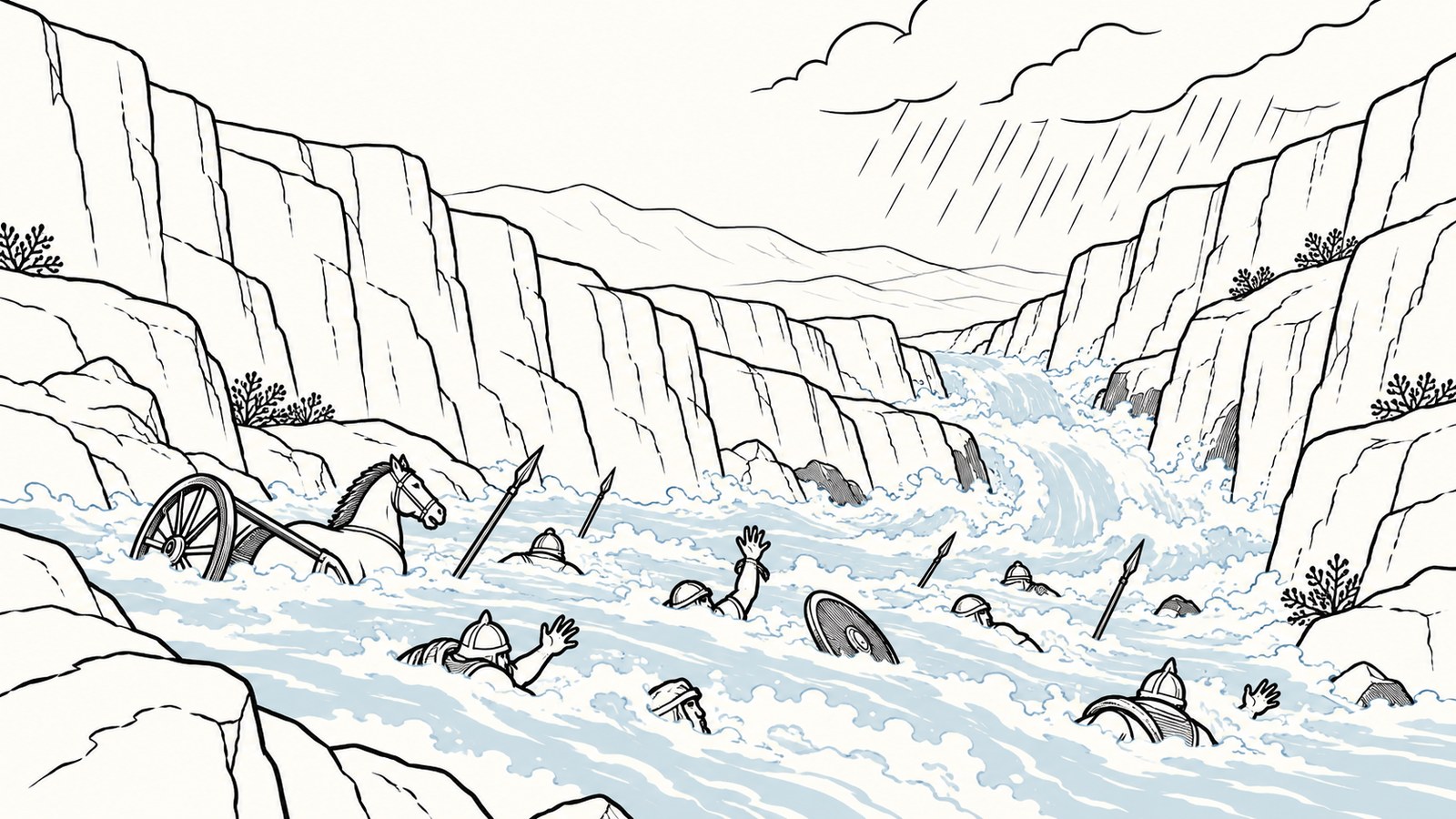
Perhaps The Book of the Wars of YHWH preserved an account of Sihon's war against Moab around Waheb, where an extraordinary storm caused the Arnon wadis to flood, destroying or routing part of the Moabite army. The surviving quotation retained only the geographical and weather-related portion because Numbers needed it to establish the Arnon boundary.
The terrain certainly makes the idea possible. A storm over steep, dry country can send water rushing down the slopes into wadis. An army fighting in those valleys could suddenly find itself battling a flood along with the enemy.
And God using weather to change a battle would hardly be unique in the Bible. Joshua describes hailstones killing Israel's enemies. In 1 Samuel, the LORD thunders against the Philistines and throws them into confusion. Most interestingly, the Song of Deborah describes Sisera's defeat by saying:
“The torrent Kishon swept them away.”
The Bible has no problem describing a military victory in which natural forces do the fighting. A modern account might say "a storm caused a flash flood that routed an army." An ancient Israelite writer could describe the same event as "YHWH fighting the battle." One explains how it happened. The other explains why.
Why Would God Help Sihon?
This is an obvious hitch in our giddy-up, but it'll all become clear in a second. If this was Sihon's war against Moab, Israel wasn't even fighting. So why would it belong in The Book of the Wars of the LORD?
Because Sihon's victory mattered to what happened next. Israel had been told not to take Moab's land. Sihon, however, took the land north of the Arnon from Moab before Israel arrived. Israel then defeated Sihon and occupied what had become Amorite territory.
In other words, Sihon's victory changed the map before Israel got there. If the biblical writers understood that chain of events as providential, then a war between two foreign kingdoms could still be part of a much larger story about what God was doing for Israel. A storm that helped Sihon defeat Moab would ultimately have helped establish the very boundary Numbers is explaining.
Maybe There Really Was a Storm
There is no way to prove a flash flood destroyed part of a Moabite army at Waheb. Waheb remains unidentified, the original context is gone, and The Book of the Wars of the LORD is still frustratingly lost. But the pieces fit well enough to make the possibility worth considering.
Waheb was probably a place. Sûp̄â really can mean storm. The very next words describe the wadis and slopes of the Arnon. Numbers tells us Sihon conquered Moab down to that exact boundary and preserves another old poem about the war. Elsewhere, the Bible repeatedly describes God using weather and water to turn battles.
Maybe Suphah was an otherwise forgotten place. Maybe sûp̄â was only a metaphor. Or maybe there was a storm.
Perhaps somewhere in The Book of the Wars of the LORD was the complete story of a battle at Waheb, a sudden storm, flooded wadis, and an army that never saw the water coming. Numbers didn't need the whole story. It needed the border.
But in quoting it, perhaps it left just enough behind to see what happened.
COMMENTS
No comments yet. Start the trouble.